


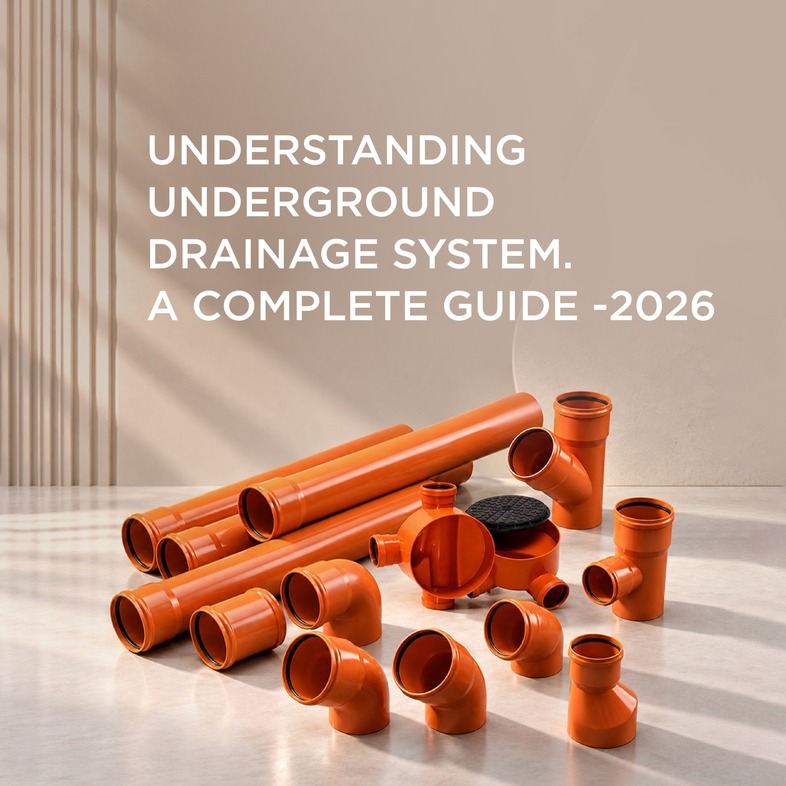
Understanding Underground Drainage System: A Complete Guide - 2026
Underground drainage systems carry wastewater and storm water safely away from homes, commercial buildings, roads and industrial sites. Since the pipes are buried, they must resist soil load, external pressure and moisture and ground movement for years. This guide covers what an underground drainage system is, why PVC is a smart choice, how inspection chambers work, and how to choose the best pipes.
What is an Underground Drainage System?
An underground drainage system is a network of buried pipes, fittings and access points that collects wastewater and storm water from a building or site and carries it to a sewer, septic tank and treatment unit or disposal point. It works mainly by gravity, so pipes are laid at a planned slope that keeps the flow moving and stops solids from settling.
A typical system includes:
- Underground drainage pipes that carry the flow from buildings to the disposal point
- Fittings such as bends, junctions, couplers and reducers
- Inspection chambers that give access for checking and cleaning
- Gullies and traps that collect surface water and block foul odours
Drainage is usually divided into foul water (from toilets, bathrooms and kitchens), surface water (rain from roofs and paved areas), and combined systems, depending on local regulations.
Types of Underground Drainage
- Foul water drainage: Carries wastewater from toilets, bathrooms and kitchens
- Surface or storm water drainage: Carries rainwater from roofs, driveways and paved areas
- Combined systems: Carry both in the same network, depending on local regulations
PVC vs HDPE Pipes: Which Is Better for Underground Drainage?
- PVC and HDPE pipes are commonly used in underground drainage systems, each offering distinct advantages. PVC pipes are lightweight, corrosion-resistant, and easy to install, making them suitable for many residential and commercial drainage applications.
- HDPE pipes offer greater flexibility and impact resistance, making them useful in areas where ground movement or challenging installation conditions may occur. Both materials provide reliable drainage when selected according to the project’s requirements.
- The choice between PVC and HDPE underground drainage pipes depends on soil conditions, load requirements, installation methods, and budget. Selecting the appropriate material helps ensure efficient wastewater flow and long-term system performance.
Importance of Using PVC Underground Drainage Pipes
PVC (Polyvinyl Chloride) is one of the most widely used materials for underground drainage, and for good reasons:
- Corrosion resistance: PVC does not rust or corrode in wet or aggressive soils, which supports a long service life.
- Smooth inner surface: Wastewater flows freely, reducing blockages and scaling.
- Lightweight: Easier to transport, handle and install, which saves time and labour.
- Leak-proof jointing: Correct jointing methods help create secure, watertight connections.
- Chemical resistance: Suitable for typical domestic and commercial wastewater.
- Low maintenance: Fewer repairs and cleaning needs over time.
- Cost-effective: A practical balance of performance, durability and budget.
PVC is well suited to residential and commercial drainage. In areas with heavy ground movement or very challenging conditions, other materials such as HDPE may also be considered, so the choice should always match the site
What is an Inspection Chamber and Its Role?
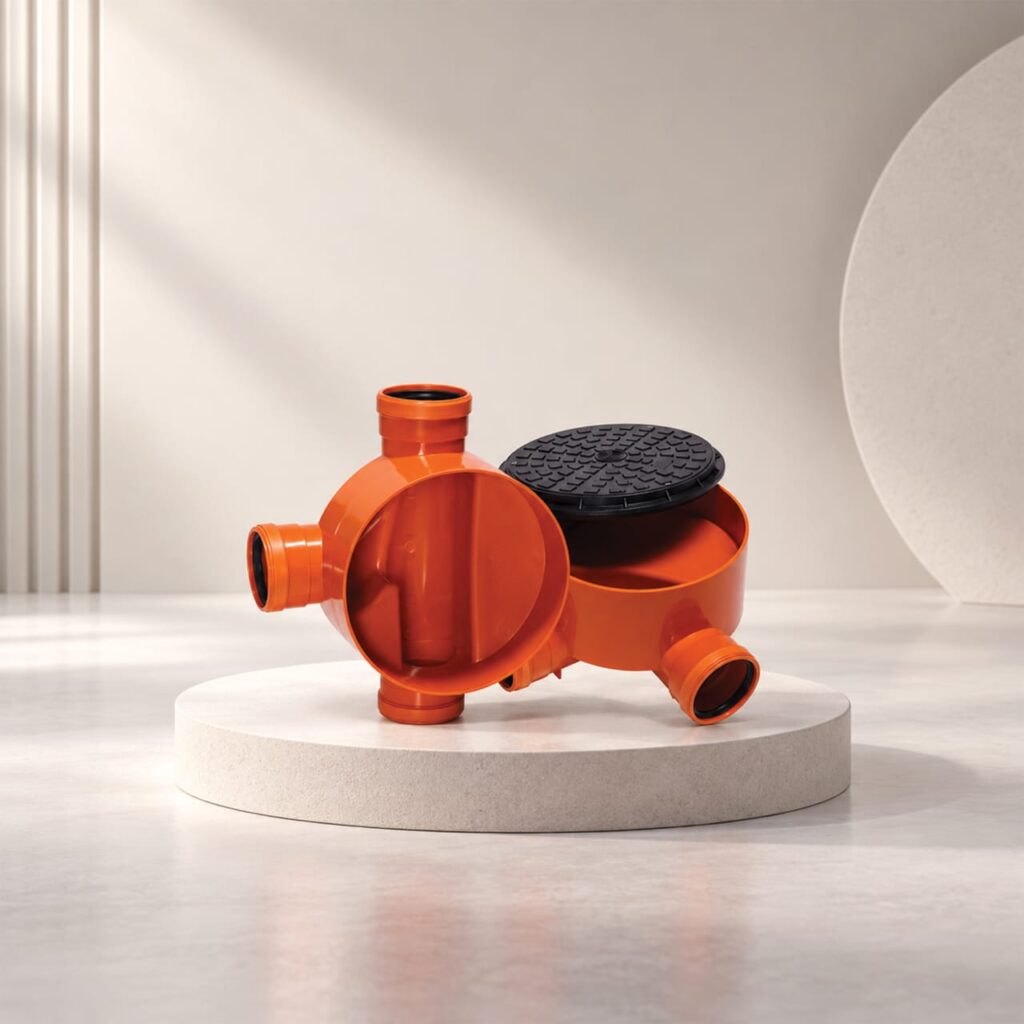
An inspection chamber, often called a manhole in larger systems, is a covered access point built into an underground drainage line. It lets you see the flow, check for blockages and insert cleaning equipment without digging up the pipeline.
Where inspection chambers are placed ?They are normally installed at the start of a drain run, at changes in direction or gradient, at junctions, and at regular intervals along long straight runs. Exact spacing and depth depend on pipe size, local codes and the project design.
Role and Uses of an Inspection Chamber
• Maintenance access: Drain rods or jetting equipment can clear blockages quickly.
• Flow inspection: Check whether wastewater is moving freely.
• Change of direction: Pipes can turn at a chamber without damaging the line.
• Junctions: Several branch drains can join the main line in a controlled way.
• Change of slope or pipe size: Chambers make such changes practical.
• Fault finding: Leaks, cracks and misaligned joints are easier to locate.
• Lower repair costs: Problems are fixed at one access point instead of excavating long stretches.
How to Choose the Best PVC Underground Drainage System
1. Check pipe strength and class: The pipe must withstand soil pressure and any traffic or structural load above it.
2. Select the right diameter: Size the pipe for the expected volume of wastewater or storm water.
3. Match installation depth and soil conditions: Deeper or softer ground may need a stronger pipe class and proper bedding.
4. Look for a reliable jointing system: Secure, watertight joints prevent leaks and root entry.
5. Plan the slope: Correct fall keeps wastewater moving and avoids blockages.
6. Choose compatible fittings: Use bends, junctions and couplers designed to match the pipes.
7. Plan inspection chambers: Place them at all required points for easy maintenance.
8. Verify quality standards: Choose pipes that meet relevant quality standards.
9. Consider total cost: Weigh price against durability, installation effort and maintenance.
Why Star Pipes for Underground Drainage Pipes and Fittings?
With a focus on quality and performance, Star Pipes & Fittings offers piping solutions designed to meet diverse infrastructure requirements. Selecting pipes that meet relevant quality standards helps support reliable drainage performance under varying site conditions.
Choose the right piping solutions for your next project with Star Pipes & Fittings and build a dependable foundation for efficient drainage systems.