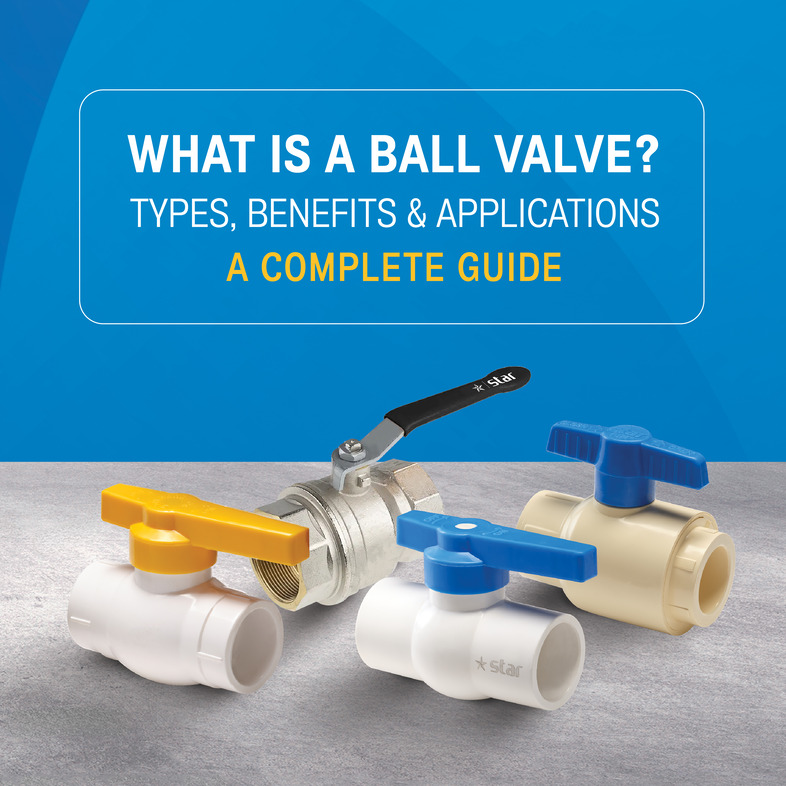
What Is a Ball Valve? Types, Benefits & Applications – A Complete Guide
Ball valves are among the most widely used flow control devices in modern plumbing and piping systems. Known for their durability, ease of operation, and reliable shut-off performance, ball valves are used in residential, commercial, industrial and agricultural applications.
Whether installed in a household water line, industrial process system, or irrigation network, ball valves provide a simple and efficient way to control the flow of water and other fluids. This article explains what a ball valve is, how it works, its applications, key features, benefits and the differences between PVC, CPVC, UPVC and brass ball valves.
What is a Ball Valve?
A ball valve is a quarter-turn valve that uses a hollow, perforated and rotating ball to control the flow of fluid. When the hole in the ball aligns with the pipe, fluid flows through the valve. When the ball is rotated 90 degrees, the flow is completely stopped.
The valve is operated using a handle connected to the ball. Because it requires only a quarter turn to open or close, a ball valve offers quick and convenient operation.
How Does a Ball Valve Work?
The working principle of a ball valve is simple: 1. Open Position – The hole inside the ball aligns with the pipeline, allowing fluid to pass through. 2. Closed Position – The ball rotates 90 degrees, blocking the flow path and stopping the fluid. 3. Partial Opening – In some applications, the valve can be partially opened to regulate flow, although ball valves are primarily designed for on/off control. This simple mechanism makes ball valves highly reliable and easy to maintain.
Common Applications of Ball Valves
Ball valves are used across various sectors due to their versatility and dependable performance. Residential Plumbing • Water supply lines • Bathroom and kitchen plumbing • Water tanks and distribution systems • Home maintenance shut-off points Commercial Buildings • HVAC systems • Water distribution networks • Fire protection systems Industrial Applications • Chemical processing plants • Manufacturing facilities • Water treatment plants • Process piping systems Agricultural Applications • Irrigation systems • Pump connections • Water distribution networks
Key Features of Ball Valves
1. Quarter-Turn Operation Ball valves can be opened or closed with a simple 90-degree turn, enabling quick flow control.
3. Corrosion Resistance Many ball valves, particularly PVC, CPVC, and UPVC variants, resist corrosion and chemical attack.
4. Long Service Life Ball valves are designed for repeated operation and long-term reliability.
5. Low Pressure Drop The straight-through flow path minimizes resistance and pressure loss.
6. Easy Installation Most ball valves are simple to install and require minimal maintenance.
Benefits of Using Ball Valves
Reliable Flow Control Ball valves provide dependable opening and closing of fluid flow.
Durability Quality ball valves can withstand years of operation in demanding environments.
Minimal Maintenance Their simple construction reduces maintenance requirements.
Fast Operation A quarter-turn handle allows quick response during maintenance or emergencies.
Versatility Ball valves are suitable for water, air, chemicals, and various industrial fluids depending on the valve material.
Cost-Effective Solution Long service life and low maintenance costs make ball valves an economical choice.
Types of Ball Valves
PVC Ball Valves
PVC ball valves are lightweight, corrosion-resistant valves commonly used in cold water plumbing, irrigation systems, water treatment plants, and swimming pools. They are cost-effective, easy to install, and suitable for applications where high-temperature resistance is not required.
CPVC Ball Valve
CPVC ball valves are designed to handle both hot and cold water systems. Due to their higher temperature resistance compared to PVC, they are widely used in residential hot water lines, commercial plumbing systems, and industrial fluid handling applications.
UPVC Ball Valve
UPVC ball valves offer excellent mechanical strength, chemical resistance, and durability. These valves are commonly used in water supply systems, agricultural irrigation networks, and industrial pipelines where long service life and low maintenance are important.
Brass Ball Valve
Brass ball valves are known for their strength, pressure resistance, and durability. They are widely used in residential, commercial, and industrial plumbing systems, particularly in applications involving high pressure, elevated temperatures, or frequent operation.
Ball Valves in Modern Plumbing Systems
Modern plumbing systems rely heavily on ball valves because of their reliability, efficiency, and ease of operation. They help simplify maintenance, improve water management, and ensure safe operation of piping networks. Manufacturers and plumbing professionals increasingly recommend high-quality ball valves as essential components in water distribution systems. Companies such as Star Pipes incorporate durable valve solutions into plumbing infrastructure projects where dependable flow control is critical.
FAQs
1.What is a ball valve? A ball valve is a quarter-turn valve that controls the flow of water or other fluids using a rotating ball.
2. What are ball valves used for? Ball valves are used in residential, commercial, industrial, and agricultural piping systems for flow control and shut-off.
3. What are the benefits of using a ball valve? Ball valves offer quick operation, reliable sealing, durability, and low maintenance.
4. What is the difference between PVC and CPVC ball valves? PVC ball valves are mainly used for cold water, while CPVC ball valves are suitable for both hot and cold water applications.
5. How long do ball valves last? High-quality ball valves can last for many years with proper installation and maintenance.
6. Where are UPVC ball valves commonly used? UPVC ball valves are commonly used in water supply systems, agricultural irrigation, industrial pipelines, and water treatment applications because of their strength and corrosion resistance.
7. When should I choose a brass ball valve? Brass ball valves are ideal for high-pressure and high-temperature applications, making them suitable for residential, commercial, and industrial plumbing systems.