August 24, 2026



Observed every year on April 25, National Plumber’s Day marks a profession that sits at the intersection of public health, engineering, and everyday comfort — yet rarely gets the attention it deserves.
Access to clean water and safe sanitation is recognised as a fundamental human right. Yet according to the World Health Organization (WHO), 2.5 billion people globally still lack safely managed sanitation. The gap between infrastructure that exists and infrastructure that actually works often comes down to one factor: the quality of the plumbing.
Plumbers do not just fix leaks. They design and install the water supply systems, drainage networks, soil stacks, and vent lines that make any building habitable. The word “plumber” itself traces to plumbum — Latin for lead, the material used in ancient Roman aqueducts. The profession is as old as cities themselves.
National Plumber’s Day is an acknowledgment that this work is skilled, consequential, and underappreciated. It is also a good occasion to understand the pipe materials and systems that define modern plumbing practice in India.
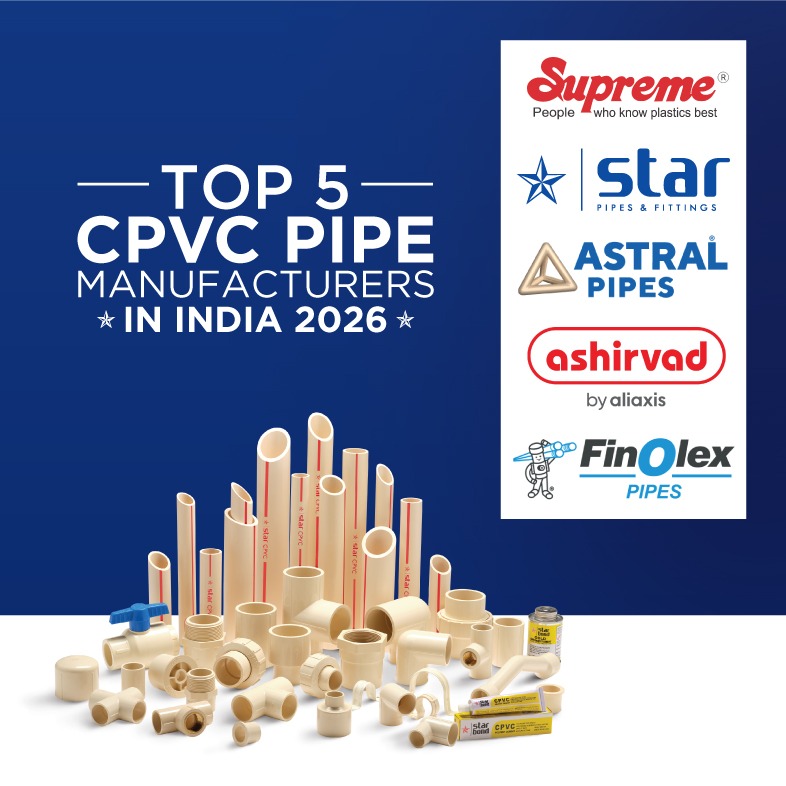
Choosing the correct pipe material is one of the most critical decisions in any plumbing project. Each material has distinct pressure ratings, temperature limits, and installation requirements governed by Bureau of Indian Standards (BIS) codes. If you are looking for a reliable source for these pipes, you can browse Star Pipes & Fittings’ full product range to understand what is available for each application.
| Material | Best suited for | Temp limit | BIS standard |
|---|---|---|---|
| uPVC | Cold water supply, drainage, borewell casing | Up to 60°C | IS 4985 |
| CPVC | Hot & cold indoor potable water lines | Up to 93°C | IS 15778 |
| HDPE | Underground mains, irrigation, sewage | Up to 60°C | IS 4984 |
| SWR | Soil, waste & rainwater drainage stacks | Ambient | IS 14735 |
| PPR | Hot water systems, chemical plants | Up to 95°C | IS 15801 |
uPVC (Unplasticised Polyvinyl Chloride) is the most widely used pipe in Indian residential construction — corrosion-resistant, pressure-rated, and chemically inert. CPVC (Chlorinated PVC) is the standard for hot water plumbing; it handles up to 93°C and is certified safe for drinking water. HDPE pipes, joined by heat fusion rather than solvent cement, are preferred for underground runs where ground movement and root intrusion are concerns. SWR pipes handle vertical drainage stacks in multi-storey buildings, designed to manage the noise and impact load of falling waste water.
Choosing between these materials is not purely a cost decision — it is a performance and safety decision. For a detailed breakdown of which pipe is right for Kerala’s high water pressure zones and humid climate, read our guide on top PVC pipe brands in Kerala.
A residential plumbing system operates on two separate, never-intersecting circuits. The water supply system delivers pressurised clean water from the municipal grid or borewell through a master shutoff valve and pressure reducing valve (PRV) to each fixture. The drainage, waste, and vent (DWV) system removes used water entirely by gravity — no pumps, no pressure required.
Vent pipes run upward through the roof to equalise air pressure behind draining water, preventing sewer gas from entering the building through dry traps. This is why vent stacks are mandatory under NBC 2016, Part 9. A system without proper venting produces persistent drain gurgling, slow drainage, and dangerous hydrogen sulphide ingress — problems that are expensive to trace after walls are sealed.
Working water pressure in Indian homes should sit between 1.5 and 3.5 Bar. Below 1 Bar, showers and mixer taps underperform. Above 4 Bar, fittings and appliance inlet valves begin to fail. Pipe materials carry a PN (pressure nominal) rating — uPVC PN10 is rated for 10 kg/cm², PN16 for 16 kg/cm². Matching the PN rating to the system’s working pressure is non-negotiable for a safe installation.
“A plumber who understands materials selects the right pipe. A plumber who understands systems designs the right network. Both skills are essential — and both deserve recognition.”
The National Building Code of India (NBC 2016, Part 9) sets the regulatory framework for all plumbing services in construction. Formal certification for plumbing professionals is available through the Construction Skill Development Council of India (CSDCI) under the National Skills Qualifications Framework (NSQF) — Level 3 for domestic plumbing, Level 5 for commercial and industrial systems.
The Bureau of Indian Standards governs material quality through IS codes: IS 4985 for uPVC, IS 15778 for CPVC, IS 4984 for HDPE, and IS 14735 for SWR pipes. These standards define wall thickness, pressure ratings, dimensional tolerances, and chemical composition — the benchmarks every professional plumber already works to.
Plumbing is infrastructure. Every correctly installed pipe joint, every properly sloped drain, every vented soil stack represents a decision that affects the health, safety, and comfort of everyone in that building — for decades. National Plumber’s Day is a reminder that behind every functioning water system is a professional who understood the materials, followed the standards, and got the installation right.
Whether it is a master plumber designing the water distribution network for a township or a service plumber tracing a hidden leak behind an apartment wall, the depth of knowledge required is considerable. The profession deserves recognition, continued investment in skill development, and the respect that comes with understanding exactly what it takes to keep water flowing safely every single day.